
Scotland’s ideas need the right backing to become global businesses

Scotland does not have a shortage of ideas
In my last column, I wrote about the crucial role Scotland can play in backing Britain’s future.

I noted that our future prosperity will ultimately be shaped by thousands of individual decisions: an entrepreneur backing an idea, a business investing in technology, or a company choosing to enter a new market. I also made the case that turning those ambitions into sustainable growth requires more than finance alone.
Access to skills and expertise matters, as do connections with potential customers and investors. Collaboration with universities, established companies and other entrepreneurs can help businesses draw on wider networks. The test is whether that support gives a good idea a real chance of becoming a successful business.
That’s the thinking behind Barclays’ Backing Britain’s Future commitment: to support 1.5 million businesses and entrepreneurs by 2030, helping companies access the skills, finance, networks and expertise they need to grow. It’s about supporting businesses across the full journey, from idea to IPO, whether they’re starting, scaling, investing or expanding internationally.
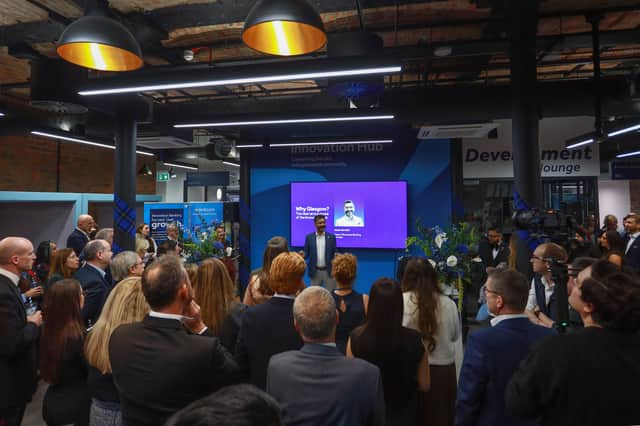
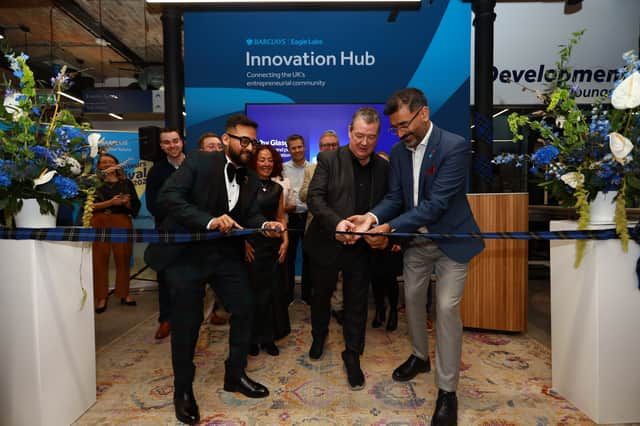
This week, that commitment is taking tangible shape in Scotland with the launch of the Barclays Innovation Hub in Glasgow. The hub is only the second of its kind in the UK, following London, and will be Barclays’ flagship innovation presence in Scotland. It represents a significant expansion of the role played by our established Glasgow Eagle Lab. Its purpose is straightforward: to connect more of Scotland’s entrepreneurs and high-growth businesses with the expertise and opportunities that can help them succeed.
The hub will bring founders and university spinouts together with investors, mentors and potential customers, with practical workshops and specialist support available along the way. Businesses will also be able to build relationships with larger organisations and showcase what they can offer to potential buyers, investors and partners who could help them enter new markets.
This is important because Scotland does not have a shortage of ideas.

Our universities are internationally respected. Our entrepreneurs are building businesses in fields ranging from artificial intelligence and fintech to energy, life sciences and advanced manufacturing. Glasgow itself has a growing technology ecosystem and considerable capability in research, engineering and digital innovation. The challenge is ensuring that more of those ideas can make the journey from research and early development to commercial success.
That journey is rarely straightforward. An entrepreneur may begin with an excellent product but need help finding a first customer. A university spinout may have world-class intellectual property but limited experience of attracting investment. A growing company may be ready to expand but unsure how to enter a new market or connect with the right international partners.
No single organisation can provide every answer. The most successful innovation economies are built through collaboration between entrepreneurs, universities, investors, major businesses, professional advisers and the public sector.
The new Innovation Hub will seek to strengthen those connections by convening a carefully selected ecosystem around the businesses it supports. Its role will not simply be to provide a place to work. It will be to help close the gaps that too often prevent promising ideas from becoming growing businesses.
Artificial intelligence will be at the heart of the hub’s programme, but this is not simply an AI initiative.
AI is changing how businesses operate across almost every sector. For some companies, the opportunity will lie in developing new AI technologies. For many others, it will be about understanding how existing tools can help improve productivity, develop products or deliver a better service to customers.
Businesses will also need support to navigate the skills, governance and responsible-use questions that come with adoption. The hub will therefore explore the full AI landscape, combining Scotland’s academic and entrepreneurial talent with Barclays’ significant technology and AI capability in Glasgow.
For me, this is what Backing Britain’s Future should mean in practice.
It means recognising that Britain’s growth will not emerge from one sector or one part of the country. It will be built by entrepreneurs turning ideas into businesses; by small and medium-sized firms investing and creating opportunities in their communities; and by British businesses developing the confidence and capability to compete internationally. It means backing ambition with more than words.
Barclays can bring together finance and relationship banking, but also specialist expertise, national networks, investor connections and global reach. Through initiatives like LifeSkills, Eagle Labs and the £22 billion Business Prosperity Fund, the aim is to support businesses at the different stages of their development.
The Glasgow Innovation Hub strengthens that proposition in Scotland by creating a clearer gateway into that wider support.
It also reflects a long-term commitment to the country. Glasgow is already home to a substantial part of Barclays’ UK technology and operational capability, alongside the community developed through the existing Eagle Lab. The hub will build on those foundations, creating stronger connections between Barclays, Scotland’s universities and the wider innovation economy.
That same approach underpins our Scotland Regional Board, which I chair. Part of Barclays’ wider UK network of regional boards, it brings colleagues from across the bank together so that our support is better connected to the needs of Scottish businesses and communities. For a business seeking to grow, that should make it easier to draw on expertise beyond its usual banking relationship.
My priority as Chair is to keep that work grounded in what we hear from businesses and our partners across Scotland, and use those relationships to help firms access opportunities for investment and growth. The Innovation Hub gives us a practical way to put that into action, connecting entrepreneurs with the wider capabilities of Barclays.
Its success will ultimately be measured by what happens next: the partnerships formed, the investment secured, the technologies adopted and the Scottish businesses that gain customers, enter new markets and grow.
When we launched Backing Britain’s Future, we set out our belief that Britain already has the ambition, talent and ideas required for long-term prosperity. Our role is to help turn that potential into investment, innovation and sustainable growth.
The new hub in Glasgow is one way we are putting that commitment into practice, supporting ambition across Scotland.
Jamie Grant is Head of Barclays Corporate Banking, Scotland
Comments
Want to join the conversation? Please or to comment on this article.