
Scotsman Obituaries: Tony Currie, Scottish broadcaster who was the first voice heard on Radio Clyde
Tony Currie, broadcaster and author. Born: 5 December 1951 in Ardrossan, Ayrshire. Died: 26 September 2026 on Lismore, aged 74
Tony Currie was the first voice heard on Radio Clyde when it launched on Hogmanay 1973, let loose without a script and given free rein to choose the first record: Kenneth McKellar’s Song of the Clyde. At the time he captured the ethos of Scotland’s first commercial radio station perfectly, saying “for Glaswegians, Glasgow is the centre of the universe and we intend to reflect that”.
Although still only in his early twenties at the time, this beloved broadcaster, who has died following a brief battle with tonsillar cancer, had been preparing for the role for years, reading his own news bulletins from the attic of his Ardrossan home and setting up his own radio station, Radio Six International, when he was just 11 years old. He would broadcast after school on specialist interests such as stamp collecting and play his favourite records on Disc-Jockey’s Roundup.
Described as “the anorak’s anorak with pro chops at the highest level”, he enjoyed a long career in broadcasting, also working for STV and BBC Scotland. Off air, he was chairman of the Royal Television Society in Scotland and Radio Academy in Scotland and a tireless encourager of young broadcasting talent. River City actor Tom Urie hailed his kindness as a mentor and described him as “a one-off”.
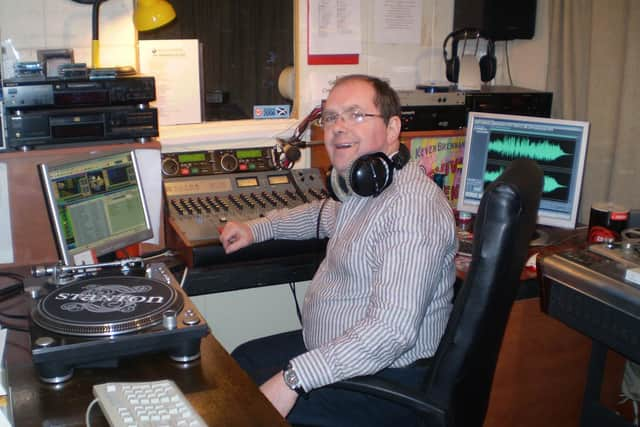

“I’m just a cog in the wheels,” Currie suggested modestly, but he had an endless appetite for new adventures. Having achieved his childhood ambitions by the time he reached his forties, he moved into new territory as an early adopter of cable television in his roles as programme controller for the Cable Authority and the Independent Television Commission and helped set up TV and radio stations around the world.
When he retired as the longest-serving TV announcer in Britain, his broadcasting days were far from over: he helmed the not-for-profit Radio Six International for a whopping 63 years, latterly broadcast from his home on the Isle of Lismore, ensuring his broadcasting baby lived up to its mission station to broadcast “around the clock around the world”.
Tony Currie was born in 1951 – he liked to point out that this was the year the radio jingle was invented. Radio was a passion from an early age. He started collecting the Radio Times from the age of four, learning to read from its pages, and developed his own primitive broadcasting set-up using an ex-army microphone plugged into a valve radio and connected to a wind-up gramophone, sufficient to set up his own station.
The ambitiously named Radio Six International was initially a hobby for Currie and his school chums but developed a semi-professional set-up in time, complete with a barely legal FM transmitter. Broadcasting to a local care home inspired him to help set up the first hospital radio service in Glasgow. Radio Six International would go on to become Europe’s first commercial cable radio station in the Eighties. It failed to attract enough subscribers to make it a going cable concern but prevails to this day as an internet station.
Currie’s first truly international radio experience was recording a weekly show, the Captain Midnight show, for Los Angeles station KPFK in the early Seventies but it was his work on the nascent Radio Clyde which made him a household voice. Clyde was a thumping success, quickly capturing more listeners than all the BBC stations combined.
Currie pointed to the UK energy crisis of winter 1973/74 as a key driver of audience figures. With TV stations compelled to go off air at 10.30pm to save on electricity, Radio Clyde could swoop in and scoop up disenfranchised viewers. But the station was a success on its own terms, reflecting local voices and concerns, with the occasional superstar takeover: Currie produced a four-hour live broadcast by Elton John in 1976, shortly before moving to STV for the next 11 years, where he was promoted from continuity announcer to chief announcer, reading the lunchtime and late evening news bulletins.
Next, he took on a succession of management roles. As Controller of Programmes for the Cable Authority, he had responsibility for 56 TV channels and 20 radio stations. He was chief executive of AsiaVision, the first Asian cable TV station in Europe, set up short-lived Irish satellite channel Tara Television and helped Perekhid Media launch radio stations in post-Soviet Ukraine.
In 1997, he returned to a public-facing role on BBC Scotland, working as continuity announcer until his retirement in 2020, following a cardiac arrest. In that time he produced and presented Radio Scotland’s overnight programming strand, Nightshift, broadcasting from the station’s new Clydeside home on Pacific Quay.
Ever the enthusiast, he wrote columns and made contributions to Scotland on Sunday, TV Times, the Guardian, the Herald, Evening Times and Times Educational Supplement as well as his beloved Radio Times, and wrote three books on broadcasting, A Concise History of British Television, The Radio Times Story and Not Quite Altogether Now!: The Pioneering Days of Radio Clyde.
Currie’s innovations did not end on retirement. Following the death of his wife Karin in 2023, he found solace in reviving legacy label Pye Records. “To bring Pye back is to breathe life into something that’s been waiting to return for a long time,” he said at the time. “You had the big labels back then like Decca, Philips and Polydor along with EMI’s Parlophone, Columbia and Stateside – and then you had Pye.”
A lifelong fan of the pop orchestras led by the likes of Tony Hatch and Herb Alpert, Currie put his name to the 36-piece Tony Currie Orchestra on the relaunched Pye’s first release, Race the Sun, a tribute to the easy listening orchestral discs which were the hallmark of the original label.
Reflecting in an online interview in 2004, he described the secret of his success as “enthusiasm. And optimism. I’ve never worked in anything I didn’t find absorbing,” adding, “I’d hate to have to get a real job”.
Obituaries
If you would like to submit an obituary (800-1000 words preferred, with non-copyright image), contact [email protected]