
The brass collar found in the Forth that tells the forgotten story of Scots enslaved by Scots – Marie Macklin
Amid calls for the UK to pay reparations to countries affected by the slave trade, Scotland should remember the horrors endured by many of its own citizens
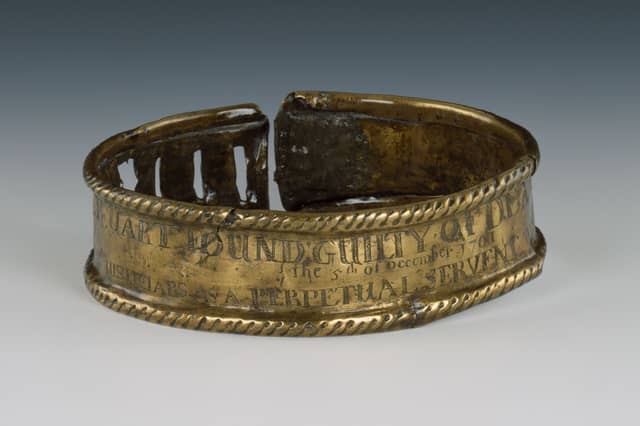

On display at the National Museum of Scotland in Edinburgh’s Chambers Street, amid the vast array of artefacts from around the globe, is a small metal object which tells an important but largely forgotten aspect of our own national story.
The relic, a brass collar, was discovered in the River Forth, and the inscription it carries bears testimony to the fact that slavery is not just something which was inflicted on people far from our own shores. It states: “Alexr. Steuart found guilty of death for theft at Perth the 5th of December 1701, & gifted by the Justiciars as a perpetual servant to Sir Jo. Areskin of Alva.”
In essence, it tells the story of a man whose death sentence was commuted to one of slavery. Such was the reality of life for some in Scotland at the turn of the 18th century. However, it was not just those on the wrong end of the penal code who found themselves condemned to “perpetual servitude”.
READ MORE: Reparations for slavery? Why Britain has already paid its dues in blood and treasure – Murdo Fraser
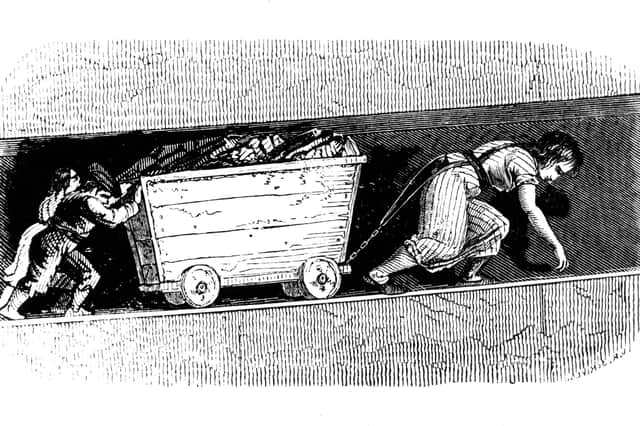
Workers punished for ‘stealing’ themselves
For many working in Scotland’s nascent mining industry, theirs was also effectively a life of slavery. The colliers and salters who toiled in the dark and dangerous surroundings of those early mines found their status, and their freedom, impacted by the law.
Early 17th century legislation dictated that any coal or salt miner who left their position for other services without due permission could be “reclaimed” by his “master” within a year, with his new employer forced to surrender him within 24 hours or face heavy fines.
Any deserting worker was to be branded a thief – the logic being that he had in effect ‘stolen’ himself – and was then to be punished accordingly.
Furthermore, the laws of the day gave the owners of those early coalmines and saltpans the authority to apprehend beggars and put them to work. In this way, the destitute were in effect enslaved under legislation which the powerful lairds and mine owners of the day were able to enforce through their wealth and political influence.
This situation, which included multi-generational hereditary servitude, prevailed for much of the 17th and 18th centuries, only coming to an end shortly before the wider transatlantic slave trade was itself abolished.
READ MORE: 9 objects that link Scotland to slavery
The reparations debate
All of this is worth recounting at a time when the debate about Britain and Scotland’s role in the slave trade has once again resumed centre stage, following comments from Andy Burnham which have edged closer to an official apology for slavery on behalf of the British state than ever before.
The Prime Minister’s recent visit to the Caribbean for the Commonwealth Heads of Government Meeting was the backdrop for the reopening of the debate, which has also seen a ramping up of suggestions that the UK should provide financial reparations for its role in slavery to those nations most affected historically by the trade.
This prompted a backlash from others who suggested it was only because of Britain that slavery was ultimately abolished, and that other nations, including African ones, also bear responsibility for what was done.
All of these arguments perhaps miss the most fundamental point however, which is that it surely cannot make sense to open the door to reparations in a world where almost any country can point to historic injustices by another. Bluntly, where would it stop?
Chains of slavery endured
Even more fundamentally, as the story of Scotland’s own slave miners shows, there is at least as compelling a case for money to be spent here at home, in and around the communities devasted by generations of industrial decline and decay.
Because while the mining slaves were finally freed by the Colliers (Scotland) Act of 1799, that did not mean an end to the suffering endured by those workers who took their place. For it could be said the chains of slavery were still firmly clamped around communities, like the Ayrshire one I grew up in, well into the 20th century.
The workers were notionally free, but in reality endured a life of misery and privation, scraping a meagre wage to put food on the table, existing rather than truly living.
Ayrshire workers like my grandfather, who worked as a miner from the 1920s to the 1940s, found life so tough that when the fair came to town, they resorted to bare-knuckle boxing to earn a few extra pennies.
One of my grandfather’s favourite singers was Paul Robeson, whose classic songs were a staple of black American culture and of those in the Deep South of the US who could trace their roots directly to slavery. Perhaps it’s no coincidence that this music, rooted in a place half a world away, could speak meaningfully to an Ayrshire miner, given the shared experience of toil and injustice.
Class-based tyranny
The transatlantic slave trade was abhorrent; a grotesque episode in our own national story and world history. That does not mean, however, that the UK of today should be expected to pay reparations when in truth so many of our own citizens live lives which are arguably blighted by historical injustices stemming from similar class-based, hierarchical tyranny as that inflicted by the slave masters.
The 17th and 18th centuries were an age when most ordinary people in Scotland and the UK were no more emancipated in terms of political power than those in Africa or the Caribbean.
Not much is known about Alexander Steuart. But the fact that his brass collar was recovered from the Forth has led to assumptions that he drowned himself. That tragic fate serves as a reminder that centuries-old injustices are universal, and that the legacy of slavery is far more complex and multi-layered than some of the voices calling for reparations are prepared to acknowledge.
Dr Marie Macklin CBE is a Scottish businesswoman and investor
Comments
Want to join the conversation? Please or to comment on this article.