
Theatre reviews: Zamboni | Harold
Lex Joyce’s play Zamboni has important things to tell us about the emotional, social and economic limbo in which too many of today’s young adults exist, writes Joyce McMillan
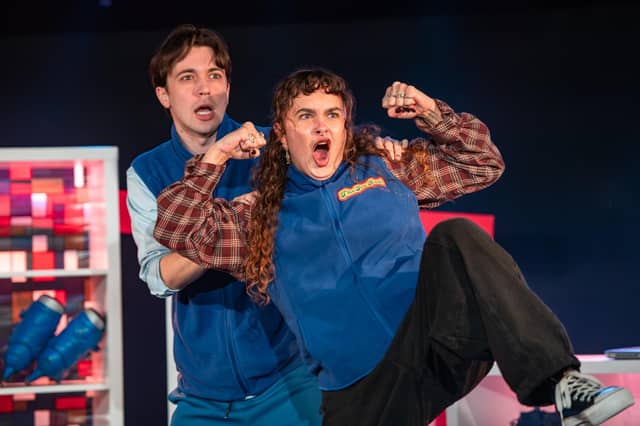


Zamboni, Oran Mor, Glasgow ★★★★
Harold, Roseburn Primary School, Edinburgh ★★★★
There’s a metaphor at the heart of Lex Joyce’s debut Play, Pie And Pint drama Zamboni; and it revolves around the Zamboni machine, used between sessions to resurface the ice at the rink where the play’s three characters work. Noa, Donal and Gus are all young twentysomethings, and all somehow a little lost and rootless in the city where they live and work.
So when tragedy strikes at the ice rink – and a young man dies in a freak accident on the ice – each of them struggles, in different ways, to deal with the disaster.
Nathan Prestwich’s motor-mouthed American Gus – who has a crush on the guy who runs the ice-rink coffee bar – tries to live as though it never happened. Loretta Francis’s Noa goes into a kind of denial, but gradually begins to work through her feelings by reconnecting with her childhood Jewish faith.
And Scottish Donal – a little older than the others, and played with feeling by Samuel Lee Johnston – is angered by their silence, and wants to talk; but ends up profoundly depressed, unable to skate, and barely eating or sleeping.
The Zamboni machine glides on after the accident, in other words, clearing up the blood, making the ice look normal; but when these young human beings try to do the same with their emotions, they find that it’s impossible.
In an age when talking about traumatic experiences has become the norm rather than the exception, it’s arguable that there’s something old-fashioned, about the central conceit of Joyce’s play, and that the characters’ instinctive suppression of their experience seems more 1950s than 2020s.
Yet there’s no denying the vividness of the characters, and the sheer dramatic force of the situation in which they find themselves. It’s as if the ice rink itself – and the nameless city in which it sits – becomes a metaphor for the emotional, social and economic limbo in which too many of today’s young adults exist; a place bereft of traditional tools for dealing with tragedy and shock, and where – for all our talk of emotional literacy – the culture too often compels people to project a self-sufficiency that is damaging at best, and at worst, a betrayal of all that it means to be human, and to need other humans to help you through.
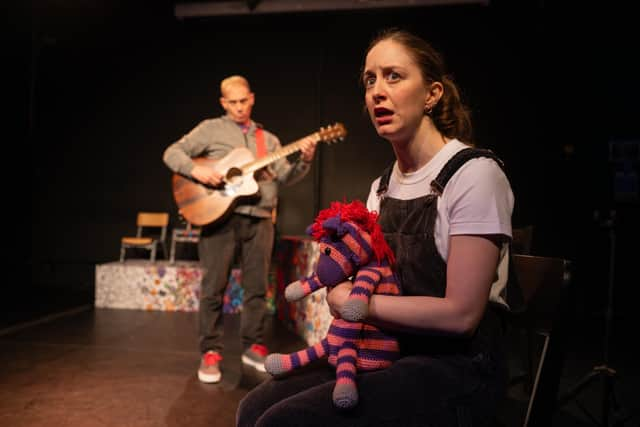
If being young is tough for the three characters in Zamboni, then Connie – the leading character in Visible Fictions’ show Harold, currently on tour around Scottish schools – is finding that being 11 is likewise no joke. In Martin McCormick’s beautifully-shaped 55-minute play for 8-11-year-olds, Connie lives with her much-loved single mum, and has always got by with the help of her favourite soft toy, Harold; not so much a teddy as a kind of knitted purple horse, with friendly listening ears.
Things are changing, though, in that Connie’s mum has recently taken up with a new partner, Bill, whom Connie naturally hates; so that just at the age when she should be giving up toys like Harold, Connie is more dependent on his reassuring presence than ever, stuffing him into her bag every day before she heads for school.
Cue a storyline that ranges across all the dimensions of school bullying, then back to Connie’s changing home life; and finally takes a swerve into the surreal, when Connie, in a dream, encounters a life-size Harold who has some home truths to impart.
In Douglas Irvine’s simple classroom production – with live music and songs by Kevin Murray – Sarah Miele plays Connie with a perfect combination of teenage rebellion and child-like vulnerability, while Simon Donaldson, on guitar, provides both the music, and the voice and presence of several other characters. The children in the audience are visibly engaged with a story that strikes close to home on so many levels; and the Visible Fictions company rolls on towards what will soon be an incredible 37th year, of providing powerful drama for children, all across Scotland.
Zamboni is at Assembly Roxy, Edinburgh, 11-15 November; Harold is on tour to schools across Scotland.
The Scotsman’s arts newsletter is now sent twice a week - subscribe today
Enjoying the Arts & Culture journalism on scotsman.com? Make it easier to find by selecting us as a preferred Google source
Want the latest Scottish headlines sent directly to your phone? Sign up to our new WhatsApp channel here
Comments
Want to join the conversation? Please or to comment on this article.